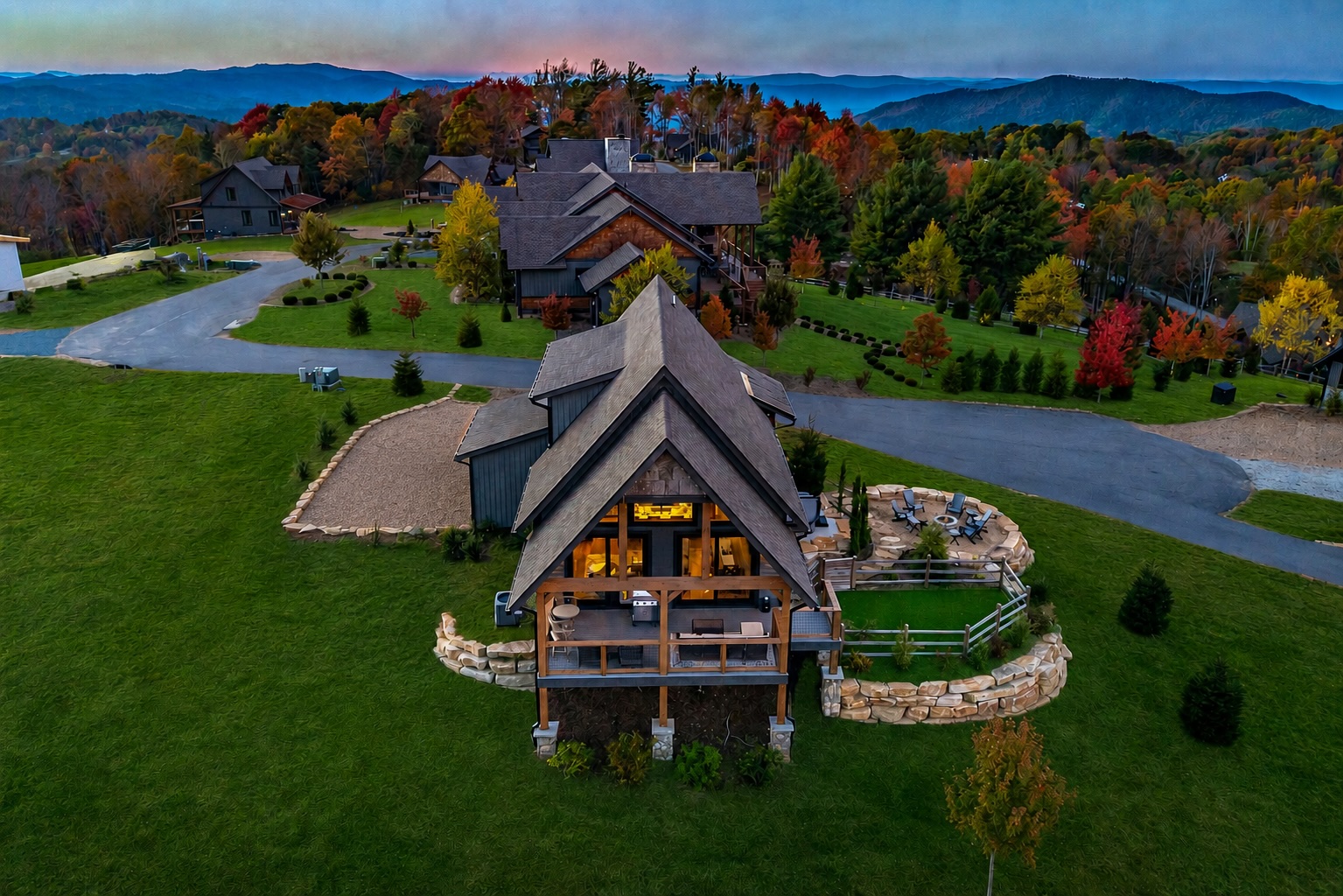
Most buyers shopping for mountain real estate ask some version of the same question: do community amenities actually affect what a home is worth, or do they just make ownership more enjoyable? In Banner Elk, the honest answer is both, but not in equal measure. Amenities rarely add a fixed dollar premium you can point to on an appraisal. What they do is shape buyer demand, influence how quickly a listing moves, and affect how a property performs as a rental or resale years down the line.
The distinction matters because it changes how you evaluate a purchase. A home with strong amenities around it isn't automatically worth more on paper, but it often attracts more buyers, generates stronger emotional responses during showings, and holds its appeal over time in ways that a comparable home without those features simply doesn't.
Lodges at Eagles Nest is a clear local example of how this plays out. The community includes Epic Chophouse, Eagles Nest Winery, the Great Camp gathering space, maintained hiking trails, and an ATV and UTV trail network. That combination gives both buyers and renters a specific answer to the question of what life actually looks like there, and that specificity is worth more than most people initially give it credit for.
Understanding how amenities drive value isn't just useful for buyers trying to make a smart purchase. Sellers benefit from knowing how to frame what their community genuinely offers, rather than just listing features and hoping buyers connect the dots on their own. The goal of this article is to give both sides a more practical lens for evaluating what amenities actually do in the Banner Elk market.
Why Amenities Matter More When Buyers Have Options
Most mountain markets give buyers a solid lineup of choices. In Banner Elk, that means a buyer might tour four or five properties in a weekend, all with comparable square footage, similar price points, and mountain views that could genuinely pass for one another in photos. When that happens, the home that offers something beyond a great view tends to be the one that sticks.
Views and finishes get buyers through the door, but they rarely close the deal on their own. A stone fireplace and wide-plank hardwood floors are expected at a certain price point. Granite countertops are practically a given. When every listing in a price range checks the same boxes, those features stop being selling points and start being table stakes. Buyers notice the similarities more than the differences, and that is where amenity-rich communities pull ahead.
The difference comes down to what a buyer can actually do with the property beyond sitting on the deck. A home inside a community with private trail access, a winery, a restaurant, and a live music venue gives a buyer a specific answer to the question of what a weekend there looks like. A home with a great view and nice finishes but nothing else gives a buyer a blank canvas, which sounds appealing in theory but can feel like homework when you are trying to justify a significant purchase.
Rocket Mortgage's home buyer preferences study found that "a home located in a neighborhood with growing amenities will drive demand and thus increase home property values all around." That finding matters here because it confirms that amenities are not just a lifestyle bonus, they are a demand driver. When more buyers want to be in a specific community, sellers in that community have a natural advantage over comparable properties that sit outside it.
There is also a psychological side to this worth understanding. Buyers shopping at the luxury end of the mountain market are not just looking for a place to sleep. They are evaluating how a property fits into the life they want to have. A community that answers that question clearly and specifically is easier to say yes to than one that leaves buyers to fill in the blanks themselves.
Selling a view is straightforward. Selling a lifestyle takes more than a view. Communities with dining, recreation infrastructure, and social programming give buyers a reason to choose a specific address rather than just a general area. That specificity shortens decision timelines and reduces the back-and-forth that often drags out negotiations when buyers are unsure whether a property is truly the right fit. Listings that can point to tangible, built-in experiences tend to generate stronger emotional responses during showings, and emotional responses are what turn a "maybe" into an offer.
What Buyers Are Really Paying For Beyond the House Itself
Two mountain homes, similar square footage, similar price range, both sitting at elevation with decent ridge views. The first one has a stunning panorama and that's genuinely it. The second sits inside a community with maintained hiking trails, a restaurant on-site, a winery, and a calendar of events throughout the year. On paper, they look comparable. In practice, buyers respond to them very differently.
The gap comes down to what each property actually gives you to do. A view is passive. You look at it, you appreciate it, and then you sit there wondering what's for dinner and whether you need to drive 40 minutes to find out. The second home answers that question before it's even asked. Trails are right there. Dinner is a short walk away. There's something happening on the weekend that doesn't require a car or a plan made three days in advance. That kind of built-in usefulness changes how a property feels during a showing, and it changes how buyers talk about it afterward.
This is where the emotional math of real estate gets interesting. Buyers don't just evaluate square footage and finishes. They mentally simulate what their life looks like inside a property, and a home surrounded by active amenities gives them a lot more material to work with. The view-only home is beautiful but static. The community home tells a fuller story, and that story is easier to fall in love with.
NAR's 2023 Community and Transportation Preferences Survey found that 78% of buyers say they'd pay more for a home in a walkable, amenity-rich community, and respondents already living in such communities report feeling happier with their lives overall. That happiness factor isn't just a soft metric. It's part of why buyers are willing to stretch their budget for a property that delivers more than shelter with a good backdrop.
There's also a practical dimension that gets overlooked. Buyers purchasing a second home or a vacation property are often thinking about how frequently they'll actually use it. A home that only offers a view requires the owner to manufacture their own entertainment every single visit. A home inside a community with dining, events, and trails removes that friction. Visits feel less like a project and more like a break, which is the entire point of owning a mountain property in the first place.
Spending more on a home that gives you less to do isn't a bargain, even when the view is spectacular. Buyers who walk through an amenity-rich community tend to leave with a specific mental image of their life there, and that specificity is what makes an offer feel justified rather than impulsive.
How Lodges at Eagles Nest Strengthens Perceived Value
Lodges at Eagles Nest has a feature list that most mountain communities simply cannot match. The Epic Chophouse gives residents and guests a proper dining experience without driving down the mountain, Eagles Nest Winery adds a social anchor that keeps people on the property, and the Great Camp serves as a gathering space that makes the community feel more like a destination than a subdivision. Layer in direct hiking access and an ATV and UTV trail system, and you have a property where owners can fill an entire weekend without leaving the gates.
That trail system deserves more attention than it usually gets. ATV and UTV access is not just a fun perk, it is a practical selling point. It means owners can use the property spontaneously on a Saturday morning rather than planning a separate trip to a trail park. When outdoor recreation is built into the community itself, it shifts how buyers think about the home's usability, and usability is a quiet but powerful driver of perceived value.
The combination of these amenities also shapes how the community performs as a short-term rental option, though that side of the equation comes with real trade-offs worth understanding. On the positive side, a property inside a community with on-site dining, wine, trails, and social spaces gives short-term renters something closer to a resort stay. As Jason Gamel, CEO of ARDA, put it, the appeal is "multi-bedrooms and full kitchens like you would find in an Airbnb but mixed with resort amenities," and that combination is genuinely hard to replicate with a standalone cabin rental.
The downside is that short-term rental activity in a community cuts both ways. Higher rental volume can mean more wear on shared spaces, more unfamiliar faces at the winery or the Great Camp, and a shift in the feel of the community that some full-time or long-term owners find frustrating. HOA rules around rentals vary, and buyers who plan to rent their property frequently need to read those rules carefully before assuming the math works out.
Rental restrictions also affect how freely you can market the property. Some communities limit rental frequency or require minimum stay lengths, which can reduce booking volume even if the property itself is attractive. Buyers treating a Lodges at Eagles Nest home as a pure income property should weigh those constraints against the premium the community commands, because the lifestyle appeal and the rental income potential do not always move in the same direction at the same time. Factoring in HOA dues is also part of this calculation, since the amenities at Lodges at Eagles Nest do not maintain themselves, and the cost of keeping the Epic Chophouse running, the trails maintained, and the winery operational shows up somewhere in the fee structure that every owner pays regardless of how often they use each feature.
Dining, Wine, and Music Create a Stronger Lifestyle Story
Outdoor recreation gets a lot of attention in mountain real estate marketing, and rightfully so. But buyers who are seriously considering a high-end mountain property are rarely thinking only about hiking trails and ski slopes. They want to know what happens after the hike, and that's where dining, wine, and live music start doing a lot of heavy lifting.
Lodges at Eagles Nest has Epic Chophouse on site, which is the kind of restaurant that changes how a community feels. Having a quality steakhouse within the community means that hosting guests, celebrating something, or just avoiding the drive into town on a cold evening are all genuinely easy. Eagles Nest Winery adds another layer to this, giving residents a destination that feels curated rather than accidental. Live music events at the winery turn what could be a quiet mountain weekend into something worth planning around.
This matters beyond convenience. When a property can be described as having its own restaurant and winery, the lifestyle story writes itself. Buyers who might not be outdoors enthusiasts still have compelling reasons to want in, which broadens the pool of people who find the community worth the price. That's not a small thing when you're trying to sell or hold onto value over time.
The broader Banner Elk area supports this story well. The town has developed a reputation for quality dining and wine experiences that sit comfortably alongside its mountain identity. Restaurants in and around Banner Elk serve the kind of food and atmosphere that wouldn't feel out of place in Asheville or Charlotte, which matters to buyers comparing mountain markets. A community that sits within reach of that dining scene gets to borrow some of that credibility.
According to the National Association of REALTORS®, over 30% of Gen Z and Millennial respondents are willing to "pay a lot more" to live in a walkable community with access to shops and restaurants. That preference doesn't disappear just because someone is buying in the mountains. If anything, buyers at this price point expect the lifestyle infrastructure to match what they'd have in a primary residence market.
What dining and entertainment amenities do is shift how a property gets remembered. Two buyers can tour the same square footage and the same mountain view, but the one who also had a glass of wine at the on-site winery and heard live music on the deck is walking away with a completely different impression. A mountain home that comes with a genuine lifestyle story, not just a setting, is a harder thing to walk away from.
Trail Networks and Outdoor Access Add Everyday Use Value
Most mountain property buyers say they want an active lifestyle, but the homes that actually deliver on that tend to have one thing in common: you don't have to get in your car to start living it. When trails, bike paths, and outdoor access are built directly into a community, recreation stops being something you schedule and starts being something you just do.
This is the difference between proximity and access. Owning a mountain home near a national forest sounds great on paper, but if getting there requires a 20-minute drive, a parking spot, and a trailhead that fills up by 9am on weekends, you'll use it far less than you think. Communities like Lodges at Eagles Nest sidestep that entirely. The ATV and UTV trail systems run through the property itself, which means a Tuesday afternoon ride is as simple as pulling out of the garage. That kind of frictionless access changes how often people actually use what's around them.
Research supports this pretty clearly. Megan Lawson, an economist and outdoor economy expert at Headwaters Economics, notes that "people with trails nearby tend to use them more," making those communities more physically active overall. Jennifer Dill, a professor of urban studies and planning at Portland State University, found that the closer homes were to such facilities, the higher the value, and that the density of those facilities within a half mile contributed even further to home prices.
The logic here isn't complicated. Buyers aren't just purchasing square footage, they're purchasing a version of their daily life. A trail network that runs through your backyard effectively means the amenity is always open, always available, and never requires planning. That's a fundamentally different ownership experience than living near outdoor recreation in a general sense.
Hiking access adds another layer to this. Trails designed for foot traffic within a community give owners something to do in the morning before coffee gets cold, which sounds small but adds up quickly over years of ownership. The cumulative effect of that kind of daily usability is what turns a vacation property into a place people genuinely want to spend more time, and that increased attachment tends to show up in how owners talk about the property when it eventually goes back on the market.
Outdoor infrastructure also broadens who the property appeals to. A buyer who doesn't ski, doesn't golf, and has no interest in wine tastings might still be completely sold on a community with serious trail access. That kind of range matters when you're thinking about resale, because the more types of buyers a property appeals to, the less dependent it is on any single lifestyle preference to find its next owner.
Why Amenities Also Matter for Resale and Rental Appeal
Short-term rental competition in the Banner Elk area is real, and it's only getting more crowded. When a potential guest is scrolling through listings, they're not just comparing bedroom counts or mountain views. According to Airbnb's own internal data, "guests often filter Airbnb search results" to find places with specific features and amenities. A home inside a community like Lodges at Eagles Nest, where guests can walk to a winery, catch live music, or hop on an ATV trail without leaving the property, simply has more to list than a standalone cabin with a nice deck.
This matters more than owners sometimes realize. Two properties at a similar price point, with similar square footage, will not perform equally as rentals if one offers a compelling list of on-site experiences and the other offers a view and a hot tub. The experience-driven property has more reasons for a guest to choose it, more reasons to leave a positive review, and more reasons to come back. Reviews and repeat bookings are what separate a consistently booked rental from one that sits empty on weekends in shoulder season.
Now shift the lens from rental performance to resale, and the same logic holds. Buyers evaluating a mountain home five years from now will still be asking what makes this property worth the asking price. If the community around the home has continued investing in its amenities, maintained the quality of its restaurant and trail systems, and kept the overall experience consistent, that home has a stronger story to tell than one sitting in isolation with nothing but acreage to justify its value.
The practical question to ask is not whether the community's amenities feel impressive on a tour today. The better question is whether those amenities will still help the home stand out five years from now, or whether they represent features that buyers will eventually take for granted. Dining, wine, live music, and maintained trail networks tend to hold their appeal because they're tied to experiences that don't go out of style.
Evaluating future marketability also means thinking about the type of buyer or renter the community attracts. A community that draws a broad mix of buyers, families, couples, retirees, and outdoor enthusiasts, tends to support stronger long-term demand than one built around a single niche. Lodges at Eagles Nest benefits from this because its amenity mix covers multiple interests at once, which means the pool of potential future buyers or renters stays wider. Narrower appeal is a risk that doesn't always show up on day one, but it tends to show up clearly when it's time to sell.
How Buyers and Sellers Can Judge Amenity Value Wisely
Start by asking whether the amenities actually match how you plan to use the property. This sounds obvious, but plenty of buyers get swept up in a glossy amenity list and then realize they have never once used a steam room or attended a private wine tasting in their life. If you work remotely and spend weekends hiking, a community built around a golf course serves you about as well as a putting green in a submarine.
The brochure version of any amenity package is always the best version. What you want to know is how those amenities actually function day to day. Some practical questions worth asking before you sign anything:
- Is access to each amenity included in HOA dues, or does it require a separate membership fee?
- Are facilities maintained consistently, or only polished up during peak sales season?
- Do the restaurant, winery, and trail systems operate year-round, or do they close for extended periods in the off-season?
- What do the HOA financials and reserve funds look like, and is the community keeping up with maintenance costs?
In mountain communities like Banner Elk, where seasonal shifts are real, year-round usability is worth asking about directly. A winery or restaurant that operates only on weekends, or a trail system that closes for three months, is not the same asset as one that runs consistently.
For sellers, the same logic applies in reverse. The amenity mix your community offers needs to appeal to a wide enough pool of buyers to support demand at resale. Zillow Research found that "features commonly mentioned in slower-selling properties are generally higher-end finishes," suggesting that niche or luxury-only appeal can narrow your buyer pool. A community whose amenities speak to a very specific lifestyle may struggle to generate broad interest when you eventually list.
The stronger play, both for buyers thinking about future resale and sellers currently marketing a home, is a community with a diverse amenity mix. Trail access, dining, social gathering spaces, and outdoor recreation together attract a wider range of buyers than any single amenity category would on its own. That kind of range means more potential buyers can see themselves living there, which is exactly what drives competition and keeps values stable.
Checking whether an amenity is genuinely usable versus just marketable is the most useful filter a buyer can apply. A private restaurant that requires a reservation two weeks out, a trail system that closes half the year, or a winery that operates only on weekends all sound great in a listing description but deliver far less than advertised in practice. The gap between what a community promises and what it consistently delivers is where most buyers either find real value or realize they overpaid for a feature they rarely get to use.
What This All Means for Buyers and Sellers in Banner Elk
In Banner Elk, buyers are rarely choosing between floor plans. They're choosing between experiences, and that distinction changes how you should think about any purchase or sale in this market.
Amenities like the Epic Chophouse, Eagles Nest Winery, live music events, and the ATV trail network at Lodges at Eagles Nest aren't just nice-to-haves on a brochure. They shape demand, influence how buyers feel during a showing, and give a property a specific story to tell when it eventually goes back on the market. A home with a great view competes with every other home that has a great view. A home inside a community with dining, wine, trails, and gathering spaces competes with a much shorter list.
That said, amenities come with real costs attached. HOA dues fund the restaurant, the trail maintenance, and the winery operations, and those numbers matter whether you're buying, holding, or selling. A community's amenities are only as strong as its ability to keep them running well year-round, which means reviewing HOA financials isn't optional, it's part of doing the job properly.
For buyers, this means shopping with a clearer filter. Does this community's amenity mix actually match how you'll use the property, and does it support the value you're paying for? For sellers, it means knowing how to frame what your community genuinely offers rather than just listing features and hoping buyers connect the dots. Understanding what amenities actually do in this market helps buyers purchase more strategically and gives sellers a clearer way to explain why their property deserves attention.